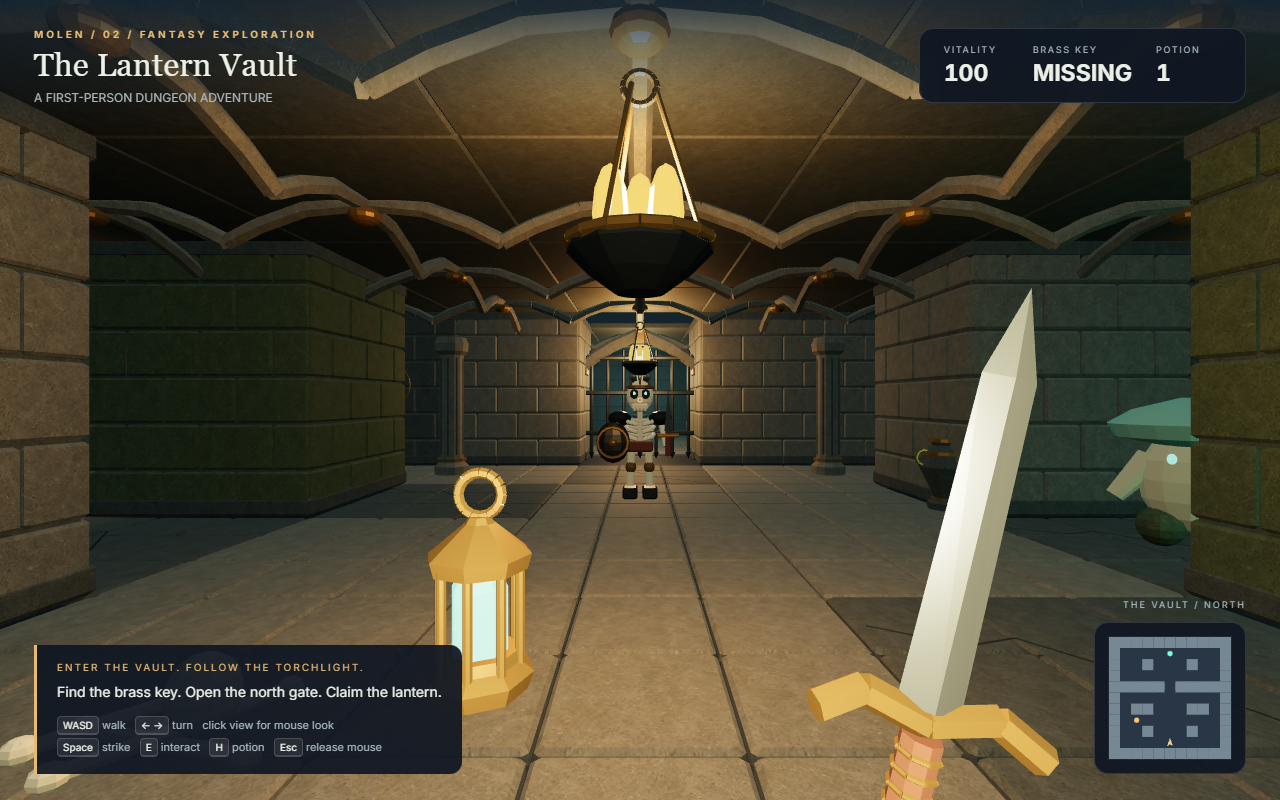
The Lantern Vault — a first-person dungeon with combat, keys and a locked gate, made from a scene manifest and scene scripts. Play it →
Deterministic by construction
Same seed, same commands, same state hash — on any machine. Randomness routes through the world RNG and math through dmath, so a replay mismatch localizes the exact diverging tick.
A complete game can be a scene manifest plus scene scripts. Entities, prefabs, commands, input bindings, camera and physics are all declared JSON, validated with pinpointed errors.
Validate, simulate, assert and screenshot without a browser. Every sample is simultaneously a demo and a regression fixture, so correctness is checkable in CI.
Every operation is exposed on the CLI and over MCP with the same I/O contract, and describe_op returns it at runtime — an agent learns the surface without reading engine source.
Everything runs from the published npm packages; Node 22.13 or newer.
sh
npx @bendyline/molen-tooling new my-experience # scene, scripts, setup, checks, a Vite appcd my-experience && npm install
Or start from one of the samples: new my-game --template skybound copies it into a project of your own (npx @bendyline/molen-tooling templates lists them). Then run the inner loop — cheap checks first, pixels last:
sh
npx molen validate scenes/main.scene.json # constantly; errors are precisenpx molen sim run main --ticks 30 --commands cmds.json --assert checks.json --hashnpx molen shot main --ticks 30 --out shot.pngnpm run dev # the same scene in the browser
Shared content (models, the default building styles, Earth catalogs, stars) comes as content packs: npx molen pack fetch https://molen.dev/packs/index.json adds them to a project.
Nine runnable experiences, from ~50 spinning cubes to three complete games. Each is a browser demo and a headless test — the intended copy-and-modify starting points. Play them all in the browser, or copy one with --template.
The whole documentation bundle is available as a flat, version-locked markdown set indexed by llms.txt. The same bundle ships inside @bendyline/molen-tooling (node_modules/@bendyline/molen-tooling/dist/docs-src/llms.txt in a project) and is searchable offline:
sh
npx molen docs search "camera track"npx molen describe # every op and its I/O contractnpx molen schema list # every formatnpx molen components # the component vocabulary